- Last reviewed
- June 8, 2026
- Best for
- First-time visitors, families, ski travelers, and multi-city routes
- Compare first
- Airport delivery, hotel forwarding, station lockers, temporary storage, or carrying the bag
- Budget logic
- Pay for luggage help when it prevents a taxi, missed sightseeing, or a difficult transfer
- Verify before relying on it
- Counter hours, cutoff time, delivery date, size limits, value limits, and hotel acceptance
Japan is one of the easiest countries for traveling without dragging suitcases everywhere, but the service only feels easy when you plan it before checkout. Luggage delivery can save a day of station stress; it can also fail your plan if you assume same-day delivery where it is not available.
Luggage decision table
| Situation | Best first check | Why |
|---|---|---|
| Land early, hotel check-in is late | Airport-to-hotel delivery or station storage | Lets you start sightseeing without carrying bags. |
| Tokyo to Kyoto or Osaka hotel change | Hotel-to-hotel forwarding | Avoids Shinkansen platforms, stairs, and crowded station walks. |
| One small carry-on | Carry it | Delivery may cost more than the friction it saves. |
| Day trip before returning to same station | Coin locker or temporary storage | Short storage is simpler than delivery. |
| Late-night airport arrival | Hotel route or private transfer | Counter hours and same-day delivery may not fit. |
| Vacation rental or apartment stay | Provider rules before booking | Some services need a staffed receiving point or extra instructions. |
Airport to hotel delivery
Airport luggage delivery is useful when you land in the morning, want to sightsee before check-in, or have a long ride from the airport to the hotel. The best case is simple: drop your suitcase at a certified counter, keep a small day bag, and collect the suitcase at the hotel later.
The risk is timing. Same-day delivery depends on the counter, destination, cutoff time, and service area. If your plan requires the suitcase that night, verify the delivery date before paying. Keep medication, chargers, passport, cash, one change of clothes, and anything fragile in your carry-on.
Hotel-to-hotel forwarding
Hotel-to-hotel luggage forwarding is often the most valuable use case for budget travelers. It can make a Tokyo to Kyoto or Kyoto to Osaka transfer feel easier, especially when your hotel is not beside the station.
Ask the hotel front desk whether they can arrange luggage forwarding and whether the next hotel can receive it. For a smooth plan, send the bag one day before the city change and travel with a small overnight bag. This is especially useful for families, travelers with large suitcases, and routes that include Kyoto buses or older neighborhoods.
Station lockers and temporary storage
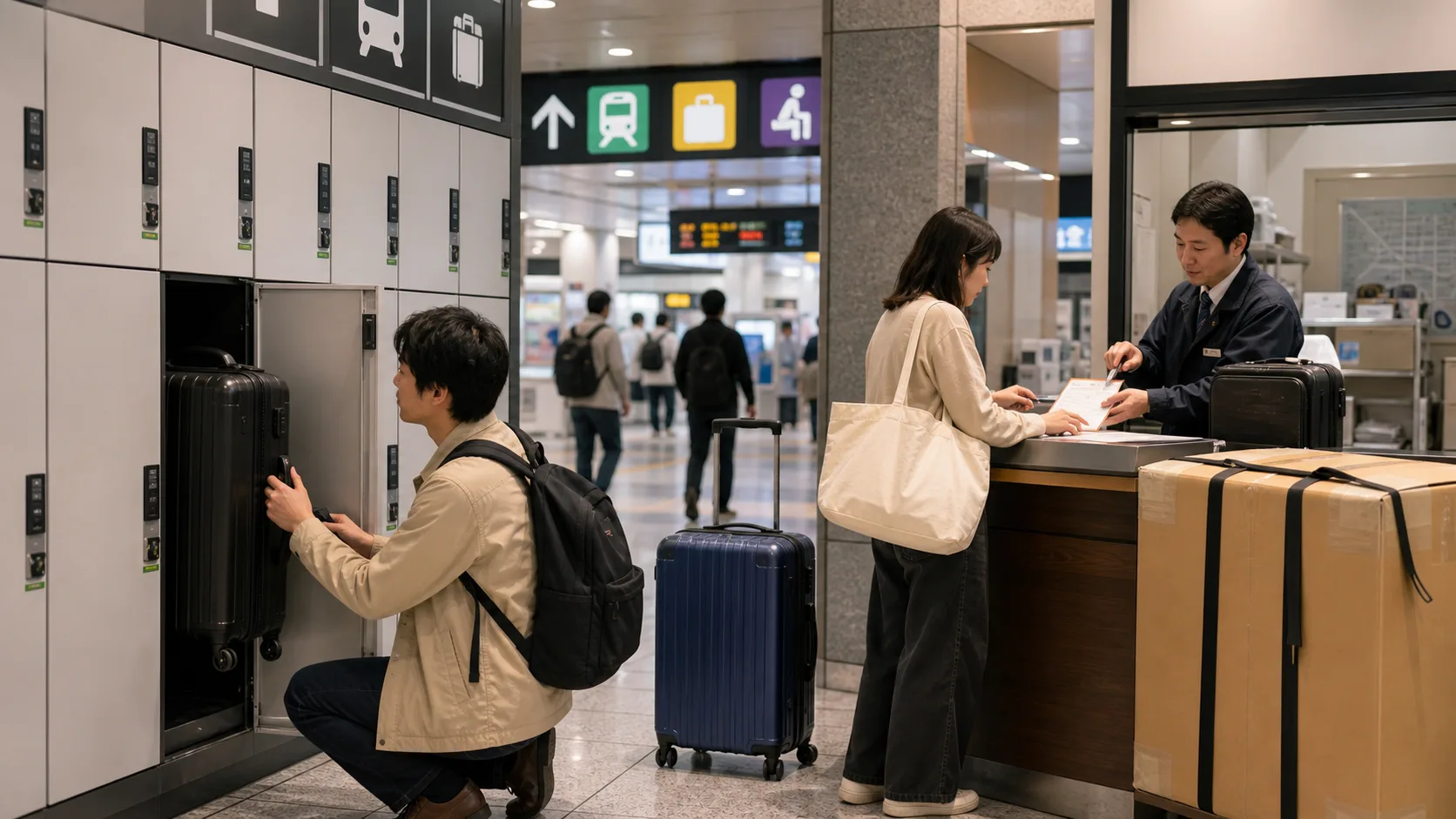
Coin lockers are best for same-day storage when you will return to the same station. They are common in large stations and tourist areas, but large lockers can fill up quickly at popular locations. Do not build a tight itinerary around finding an empty large locker at peak time.
Temporary storage counters can be more reliable for big bags, but hours vary. If you need your bag after dinner, check the closing time before leaving it.
When carrying is still better
Delivery is not always the budget answer. If your bag is small, your hotel is close to a direct station route, and you are not changing cities, carrying the bag may be simpler. The goal is not to avoid all luggage; the goal is to avoid expensive or exhausting luggage friction.
One carry-on and a direct train usually does not need delivery.
Use lockers or storage when you need the bag again the same day.
Forward bags when the alternative is a crowded station or taxi.
A bus, taxi, or private transfer may beat delivery if you need the bag immediately.
Budget math
Think of luggage delivery as a substitute for time, stress, and sometimes taxis. If sending a suitcase lets two people avoid a long taxi ride, recover a sightseeing day, or keep a hotel in a better-value area, it may be worth it even on a budget trip.
It is less attractive when it adds a separate errand, forces you to pack an overnight bag, or solves a problem you do not actually have. Put it in the same decision set as airport buses, hotel area choice, and private transfers.
Before you send luggage
- Confirm the destination hotel can receive luggage before you arrive.
- Check counter hours, cutoff time, delivery date, and pickup location.
- Ask about size, weight, value, fragile item, and prohibited item rules.
- Keep passport, medication, payment cards, chargers, valuables, and one outfit with you.
- Photograph the waybill or tracking information before leaving the counter.
- Pack a small overnight bag if delivery is next-day or date-specific.
Sources and current checks
Rules and service counters change. Start with JNTO's luggage and storage guide for the official overview, then verify current service details with Yamato Transport's Hands-Free Travel information and the airport or hotel you plan to use.
FAQ
Can I send luggage to a hotel before check-in?
Often yes, but do not assume. Confirm that the hotel accepts guest luggage deliveries, and include the guest name, booking name, and check-in date exactly as the hotel requests.
Is luggage delivery better than a taxi?
For one or two travelers with time, delivery plus public transport may be cheaper and calmer. For late arrivals, families, or travelers who need the bag immediately, a taxi, airport bus, or private transfer can be more practical.
Can I use luggage delivery for Airbnb-style stays?
It is more complicated because there may not be a staffed front desk. Check provider instructions before booking and be ready to use a service counter or hotel storage instead.
One bag decision can change whether a cheap hotel still feels cheap after the transfer.
Use the Hotel Booking ChecklistSend the suitcase only when it removes a real bottleneck. The cheapest-looking plan is not cheap if it ends with a tired taxi ride.